$ cat valley-of-flowers.md
The Valley That Didn't Care I Was There
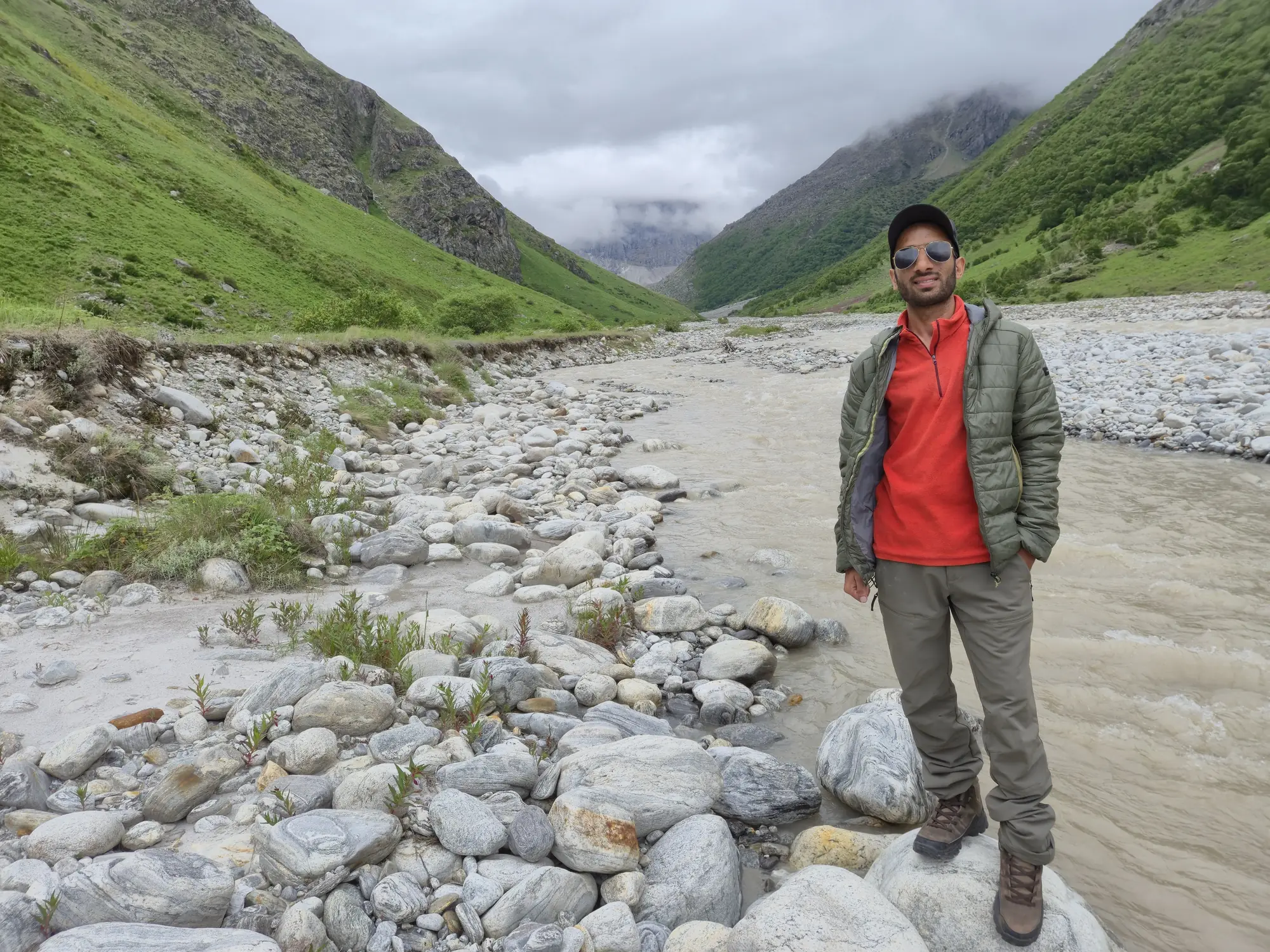
I almost didn't go.
The trip had been on my list for three years — one of those things you bookmark, screenshot, tell yourself next summer, and then watch another summer pass. But in August I finally ran out of excuses, packed a bag that was definitely too heavy, and took the overnight train to Haridwar. I had no idea what was about to hit me.
Day one: just getting there is the experience
The drive from Joshimath to Govindghat is the kind of road that makes you reconsider your life choices every fifteen minutes — cliff on one side, river thundering below on the other, and a driver who treats hairpin bends like gentle suggestions. I had my eyes closed for most of it.
But then you step out at Ghangaria, after a 13-kilometre walk through rhododendron forest with the Pushpawati river keeping you company the whole way, and something settles. The noise in your head quiets. I remember thinking: oh, this is what people mean.
The valley itself
Nothing prepares you for the morning you walk into the Valley of Flowers for the first time.
It's not dramatic in the way the Himalayas usually are — no savage ridge, no terrifying exposure. It's softer than that. The valley opens up gently, and then you realise the entire floor, as far as you can see, is covered in wildflowers. Primulas, blue poppies, brahma kamal, cobra lilies, a hundred other species I couldn't name. The colours shouldn't coexist — deep violet next to blood red next to the palest yellow — but they do, and somehow it looks exactly right.
I sat down on a rock and just... stayed there. I didn't take photos for the first twenty minutes. Some things you want to actually see before you start worrying about the frame.
The valley was declared a UNESCO World Heritage Site in 2005, but standing in it you understand that no designation does it justice. It's 87 square kilometres of flowers at around 3,500 metres, with glaciers above and mist drifting through in slow, theatrical waves. In the monsoon — which is when you must visit, because that's when everything blooms — the light is strange and beautiful, the kind of soft grey-gold that makes everything look slightly unreal.
The part nobody warns you about
It rains. A lot. Real monsoon rain, not a drizzle.
On my second day in the valley, the clouds came in around noon and it started to pour. I was about four kilometres from the entrance, nowhere near shelter, and I had a jacket that was waterproof in theory but not in practice. Within twenty minutes I was soaked through. I had to pick my way back over wet rocks and muddy trail, laughing to myself because there was nothing else to do about it.
I'd do it again without a second thought.
There's something about being rained on in a place that beautiful that doesn't feel like suffering. The flowers don't care about the rain. The river gets louder. The mist thickens over the glaciers. The valley is just being itself, and you are a small wet guest inside something ancient and indifferent, and somehow that's the most peaceful feeling I've had in years.
Hemkund Sahib
If you go to Govindghat, you must also go to Hemkund Sahib — the Sikh gurudwara that sits beside a glacial lake at 4,329 metres. It's a steep climb from Ghangaria, around six kilometres, and the altitude hits hard in the last kilometre. I stopped every hundred steps and told myself I wasn't stopping, just looking at the view.
The lake is perfectly still when the wind isn't blowing, surrounded by seven peaks, with the white gurudwara dome reflected on the surface. Pilgrims come here — some elderly, some in poor health — making a journey of pure faith. I'm not a religious person but I defy anyone to stand at that lake and feel nothing.
The langar inside the gurudwara — free food, served to everyone who comes — was the best dal I've ever eaten. I had two helpings and then sat on the steps looking at the water for a long time.
What I brought back
Tired legs. A collection of blurry rain-smeared photographs. A pressed cobra lily that I probably shouldn't have picked but did anyway.
And something harder to name — the particular feeling of having been somewhere that existed entirely on its own terms, with no interest in you at all, and having been grateful just to witness it.
The Valley of Flowers has been there for longer than anyone knows. It will be there after all of us. The flowers bloom every monsoon whether anyone sees them or not. Going there doesn't change that, but it changes something in you — some recalibration toward smallness and beauty and the understanding that the world contains things that are worth an overnight train, a rainy climb, and a jacket that doesn't work.
Go. Take a real raincoat. Leave your phone in your pocket for at least the first ten minutes.
Trust me on the ten minutes.